Prague
1921–1939Otto Löwy was born in Prague on 4 March 1921, the only son of Arnošt (Ernst) Löwy, a commercial representative, and Erna Löwy, née Holzner. He was fluent in both Czech and German. He spent part of his teens with his mother in Plzeň, and was educated at a Realgymnasium and a business academy.
The Prague of his childhood ran all through his later broadcasts. He remembered fetching his father in the late afternoons from the Blue Star coffee house, where his father “did not drink, just played”; going to the races with his father at the age of about six; passing the Hotel Alcron every day on his way to school; and seeing the operetta White Horse Inn as a boy. His mother, he recalled, went on playing bridge in her coffee house right up to 15 March 1939, the day the German army marched in.
Refugee in Britain
1939–1943On 27 March 1939, less than two weeks after the occupation, his parents put him on a train for England. He crossed into the Netherlands on 30 March and reached London the next day, aged eighteen. He never saw his parents again.
“On my second day in England, I was given in Russell Square, a pair of flannel pyjamas, a yellow slicker, a pair of Wellingtons, and 2/6.”“Buskers” · 1996
His first months were spent at a hostel for Czech refugees near Cardiff, in Wales. In London he found the refugees' unofficial meeting places: the lobby of the Cumberland Hotel at Marble Arch, where friends could sit for hours “without having to spend any money, which we simply didn't have”, and the Lyons Corner House, where a cup of coffee cost sixpence and the cloakroom girl, the waiters and the boy carrying the water glasses were all refugees too.
“Without ever having met, the waiters knew very well who we were, and we knew who the waiters were. No words were spoken … a silent conspiracy. We were all in the same boat.”“Albert Sandler” · 1996
On 3 September 1939, when war was declared, he was picking hops at Tenterden in Kent, lodged with other young refugees in old railway carriages in a meadow. For the next four years, in his own words, he “worked in the war industry and in various farms”; by 1943 he was living in Oxford and working in a dairy. On leave in London he danced at the Astoria, the Hammersmith Palais and the Café de Paris.
The Czechoslovak airmen of the RAF
1943–1946On 29 April 1943 he enlisted in the Czechoslovak forces in Britain at the Czechoslovak Legation in London. After infantry training at Peterborough he transferred in July to the Czechoslovak units of the Royal Air Force, and served as ground crew, a mechanic and equipment assistant, with No. 312 (Czechoslovak) Squadron and its servicing echelons.
His first posting took him by blacked-out train from Cardiff to Thurso and by boat to Orkney, where the squadron was stationed at RAF Skeabrae; fifty years later he still remembered “Kirkwall, the capital, and Stromness, the only other town”. He then followed the squadron's Spitfires around the airfields of southern England: Ibsley, Appledram on D-Day, Tangmere, Lympne in the summer of the flying bombs, North Weald, Bradwell Bay and Manston. He rose to sergeant and was awarded the Czechoslovak Military Commemorative Medal, the Czechoslovak Medal for Merit and the British Defence Medal.
The return
1945–1948In July 1945 he went home to Prague with the Czechoslovak air force. There he learned what had happened.
“After returning home I found out that the whole big family was murdered by Germans.”Otto Lowy · written statement · 2002
His father had been deported to Terezín in July 1942 and then to occupied Belarus, where he was killed. His mother was deported to Terezín in December 1941 and to Auschwitz in October 1944. Lowy later wrote about his search for her in the radio monologue 40 Years Ago and in The Return – 1945.
In December 1945 he went back to London. He received his RAF discharge certificate in February 1946, began civilian life as a waiter in a Czech restaurant on the Edgware Road, and in January 1947 became a British subject. On 15 May 1948 he sailed from Southampton on the Queen Mary, bound for Canada.
Canada
1948 onwardFamily connections took him to New Westminster, British Columbia, and to Pacific Veneer, the plywood company founded on the Fraser River by Viennese émigrés and later part of Canadian Forest Products (Canfor). He worked there for thirty-one years, until 1979, as a laboratory technician in the plywood and hardboard division, while writing, acting and broadcasting in his own time. He became a Canadian citizen in 1954.
He placed his first bet at a Canadian racetrack in 1949, and horse racing stayed his great hobby: for forty years he spent his weekends at Exhibition Park, studying the form beside his friend Vic.
Stage, radio drama and screen
1950–1991By October 1950 he was on the Vancouver stage, and through the 1950s he was a mainstay of Vancouver Little Theatre as actor, director and member of its executive. He directed from 1953, and when the Arts Club opened its first theatre in 1964 he was involved from the start, going on to direct seventeen productions there. He staged musicals for Theatre in the Park at the Malkin Bowl, among them My Fair Lady, Oklahoma! and Camelot, as well as opera and operetta.
From 1955 he wrote for CBC Radio drama: original plays, among them the three-part spy serial Champagne Safari, and dozens of translations and adaptations that brought Central European drama, from Schnitzler and Brecht to Dürrenmatt, Frisch and Václav Havel, to Canadian listeners. He acted in film and television from 1958 to 1991, from The Littlest Hobo and The Beachcombers to Airwolf.
The Transcontinental
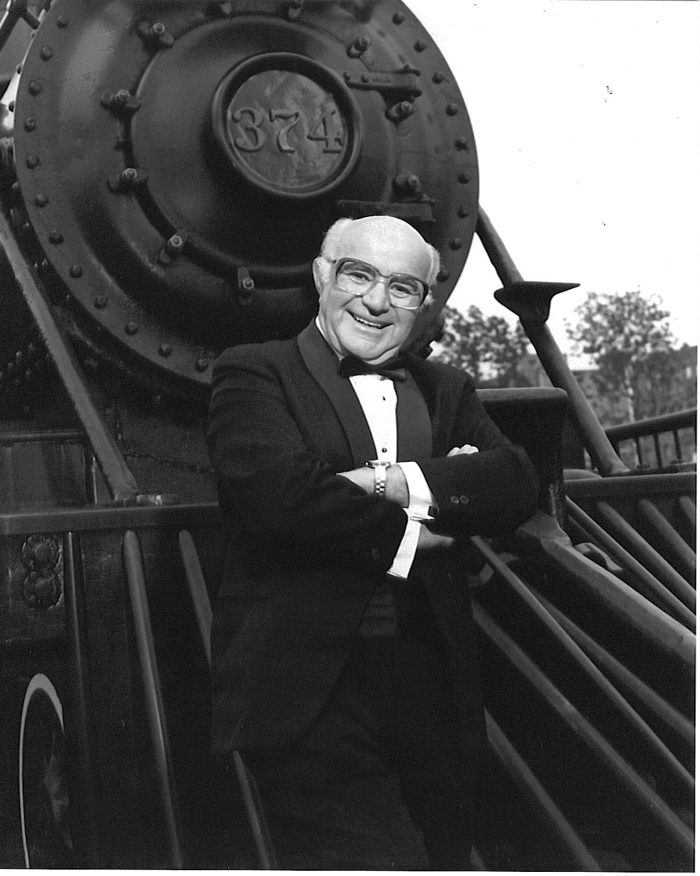
1980–2002In 1978 he created and hosted A Night at the Operetta for CBC Stereo. Its success led to The Transcontinental, which began in 1980: a weekly journey aboard an imaginary luxury train, introduced by the theme from Murder on the Orient Express, through the music, history and memory of Europe. Each programme filled exactly fifty-five minutes. He wrote every script by hand, researched it at the Vancouver Public Library and in the CBC Vancouver record library, and timed the records himself with a stopwatch.
The 500th programme went to air on 4 March 1990, his 69th birthday. He also wrote and narrated concerts, above all the Vancouver Symphony's Tea & Trumpets, and hosted CBC broadcasts from Expo 86, the 1994 Commonwealth Games in Victoria, Romania and Yugoslavia.
Honours
1984–1999- 1984ACTRA Award nominations as best actor (Kafka in Love) and as best host-interviewer (The Transcontinental).
- 1987Gemini Award nomination for documentary writing (Man Alive, “The Precious Legacy”).
- 1994Austria's Gold Cross of Merit for Science and Art, First Class, and an honour from the province of Lower Austria.
- 1998BC Entertainment Hall of Fame, with a star on the Orpheum's Theatre Walk of Fame.
- 1999Masaryk Award of the Czechoslovak Association of Canada, and the Czech Republic's President's Award, brought to Canada by President Václav Havel.
Last journey
2002The last Transcontinental went to air on 26 May 2002. Otto Lowy died in Vancouver two days later, on 28 May, at the age of 81. On 4 June Senator Frank Mahovlich rose in the Senate of Canada to pay tribute to him.
“Last week Canada lost one of its greatest storytellers.”Senate of Canada · 4 June 2002
In 2003 the Czech Republic formally recognised him as a participant in the national struggle for freedom, for his war service.